
This chapter follows Sample Holdings Ltd for FY2026. It is in local review and not yet certified: two approvals are still to sign.
Bind the reviewed trial balance
A cycle starts from a trial balance whose accounts are all categorised and accepted by a reviewer. Sample Holdings Ltd 2026 has 24 of 24 accepted, balanced at £6,504,900.00, with an accounting profit of £880,000.00. Binding records the hash of those balances so the workings can later prove which figures they used.
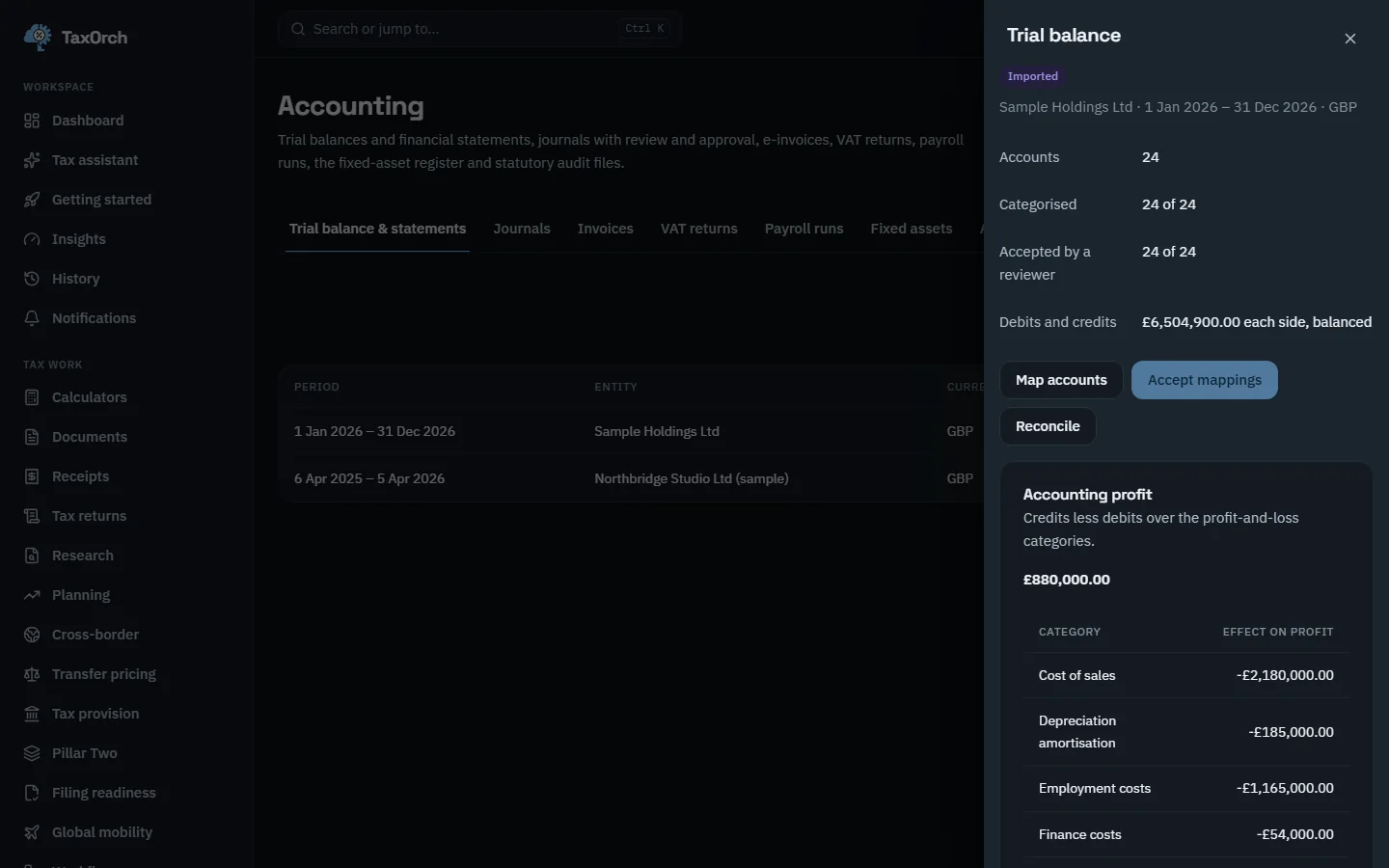
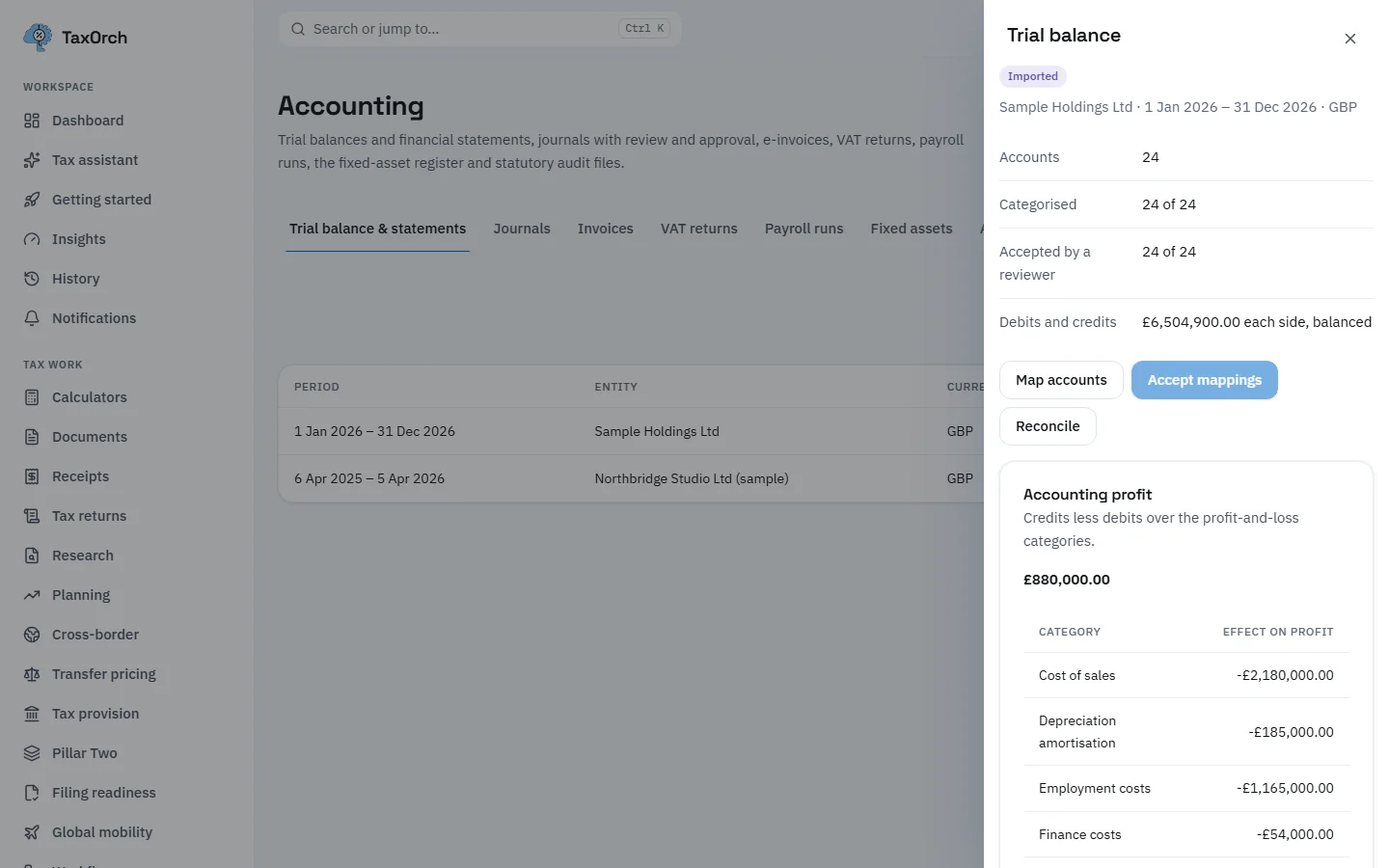
The reviewed trial balance the cycle binds: balanced, fully accepted, £880,000.00 accounting profit.
Declare the bases
The basis statement names what the cycle is computed on: the accounting framework (IFRS, IAS 12 with the 2023 amendments) and the tax law (CTA 2009 as at 31 December 2026). Both are versioned so a later change cannot silently alter a computed figure.
Record and review the schedules
Seven linked components: credits and losses, currency, current tax, deferred tax, disclosure, rates and uncertain positions. Each shows its state, key figures, who prepared it and who reviewed it. On the sample cycle every schedule is Reviewed: taxable profit £867,400.00 on accounting profit £880,000.00, current tax charge £216,850.00, deferred tax charge £6,250.00, total tax expense £223,100.00 and an effective rate of 25.35%.
Select a schedule to see its workings line by line, recorded against both basis versions and the hash of the bound balances.
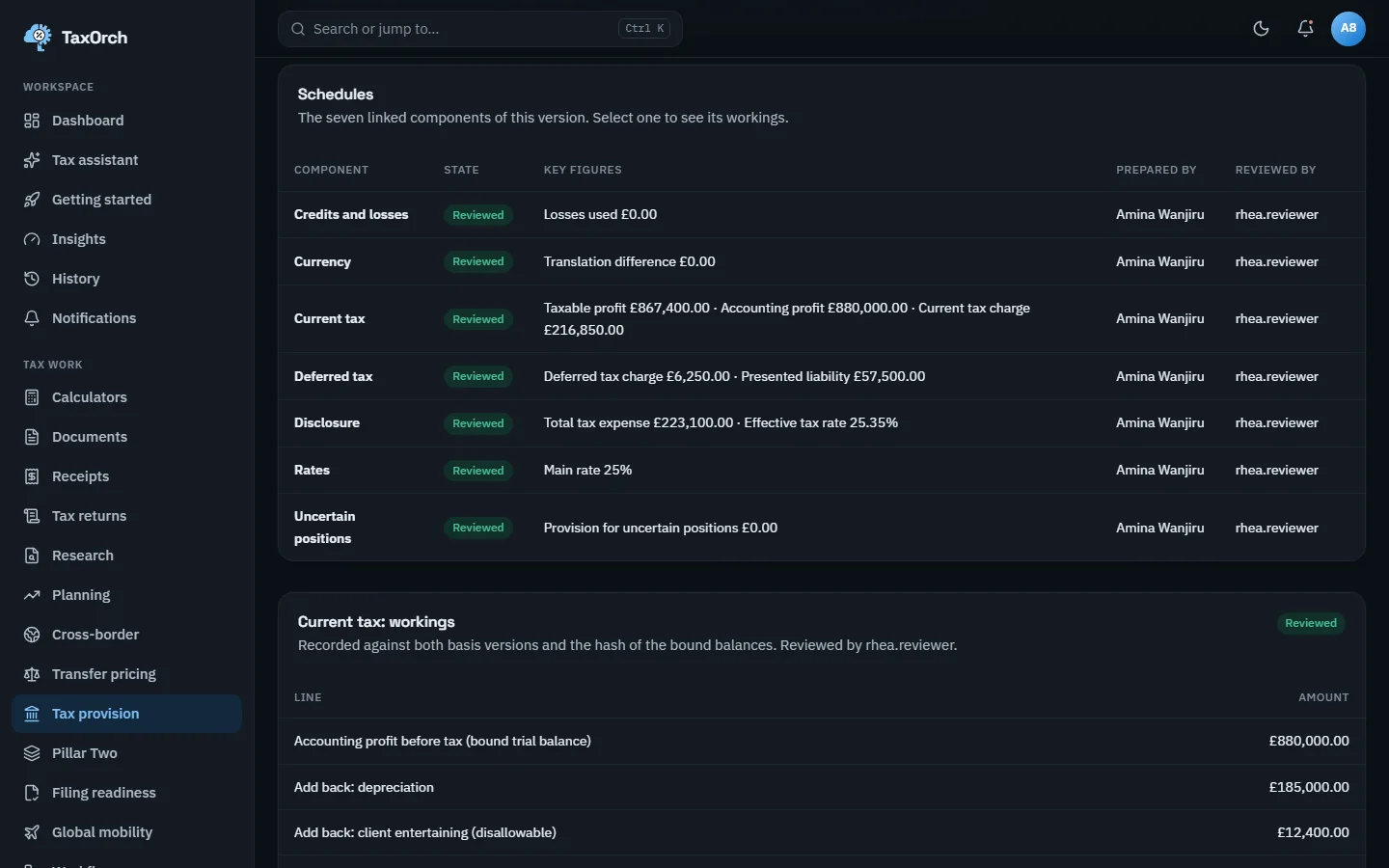
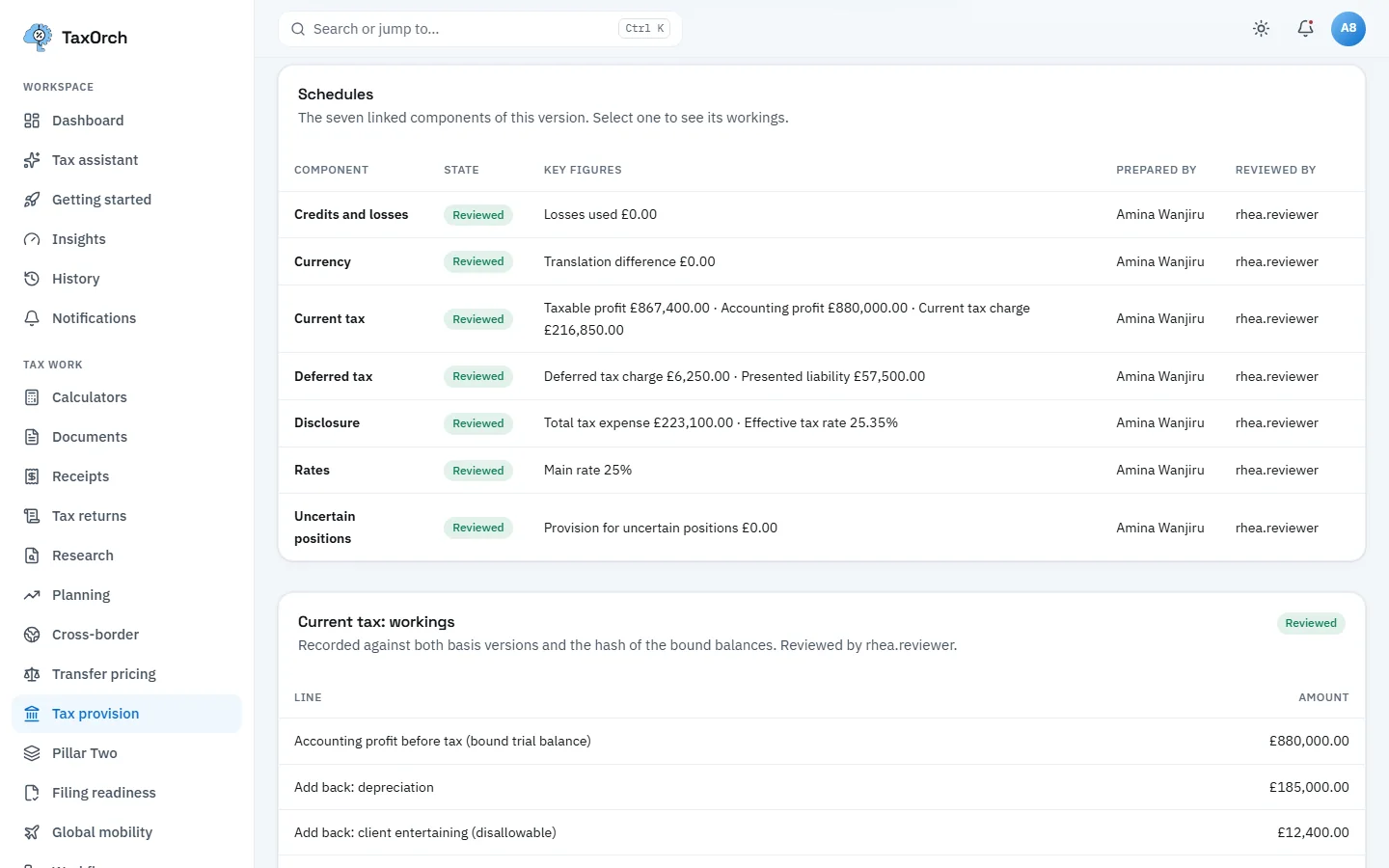
Seven schedules, each prepared and reviewed by different people, with the current tax workings opened.
Check close readiness and sign the stages
Close readiness runs five named checks: schedules complete, balances reconciled, rules supported, critical review notes cleared, approvals signed. On the sample cycle four pass and approvals are outstanding: still to sign, regional review and consolidated review. The close state reads Local review, close version 1, certified Not yet, journals may post Yes.
The Readiness to compute panel is separate: bases declared, perimeter approved and current, sources bound and unchanged. Nothing computes until every check passes.
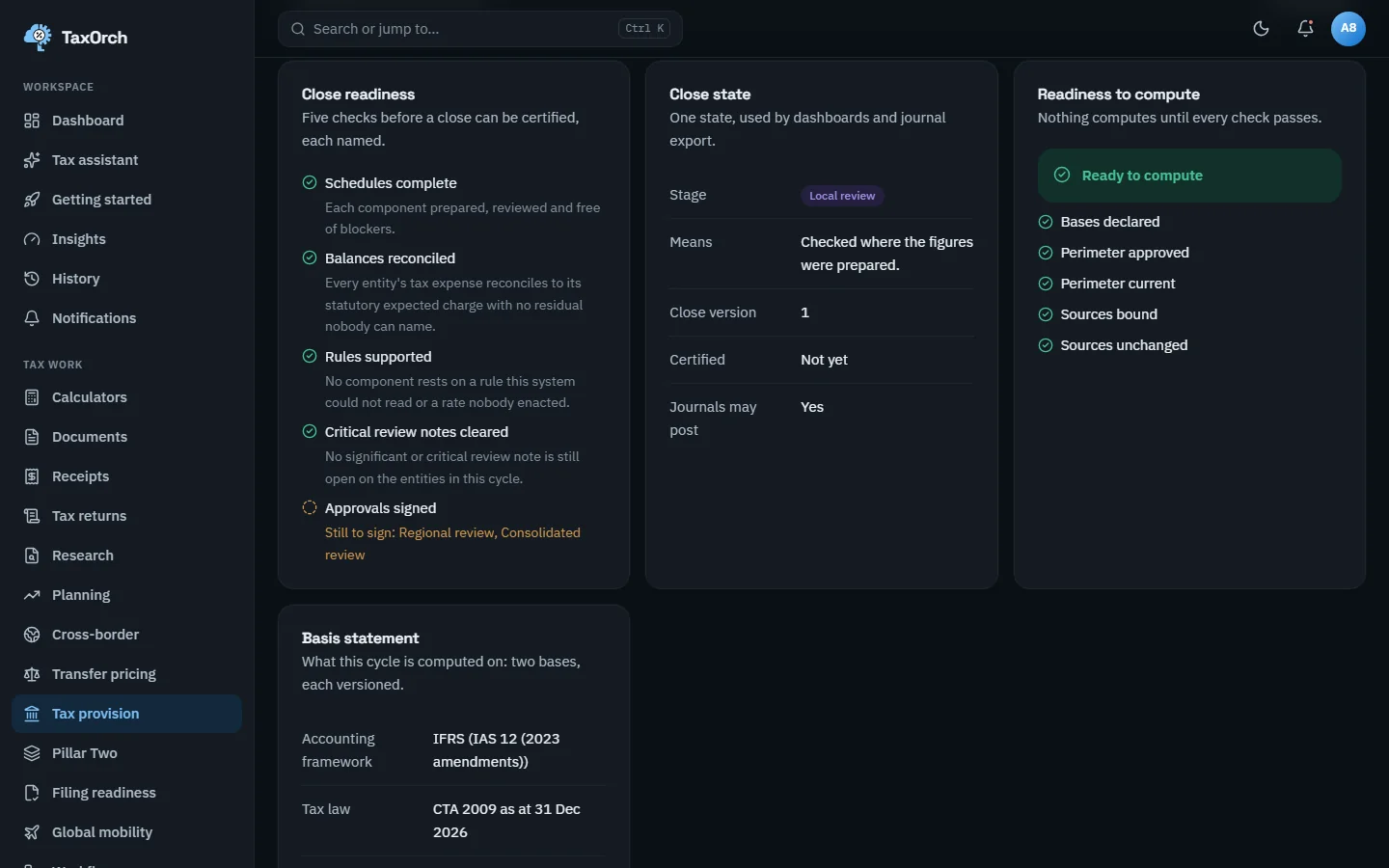
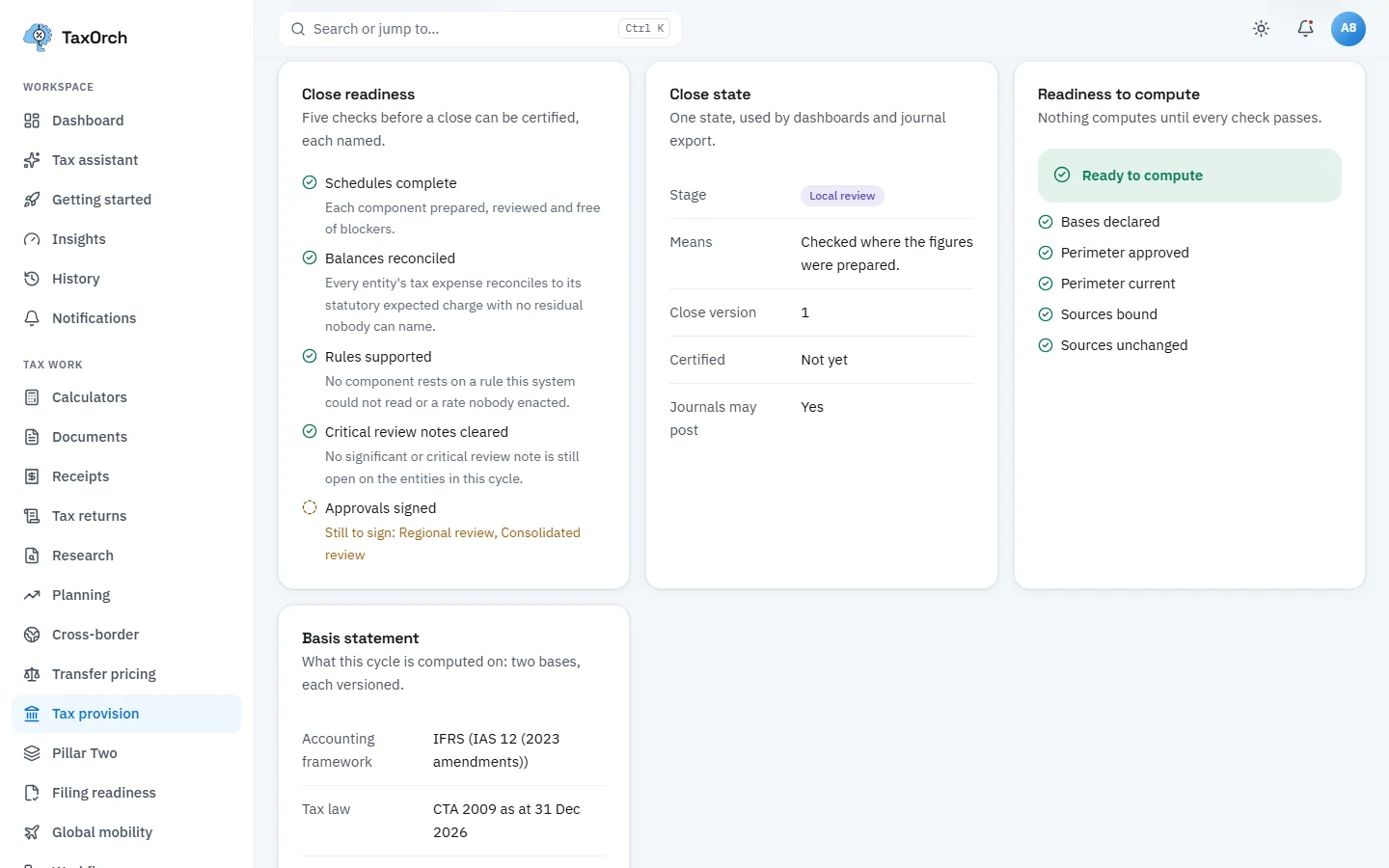
Close readiness: four of five checks passed, two approvals still to sign, and the declared bases.
Record Pillar Two entities and inputs
Pillar Two lists every entity in the group, its jurisdiction, kind and ownership, and the GloBE inputs recorded for it: net income (FANIL), covered taxes, payroll and tangible assets, in GBP under IFRS. The sample group has four constituent entities in NL, DE and GB.
Computations run one per jurisdictional pool. On the sample dataset all three pools are Unsupported: no verified rules covers the jurisdiction for the period, and computing on the nearest year's numbers would produce a rate somebody could act on. The reason is shown; nothing is shown as nil.
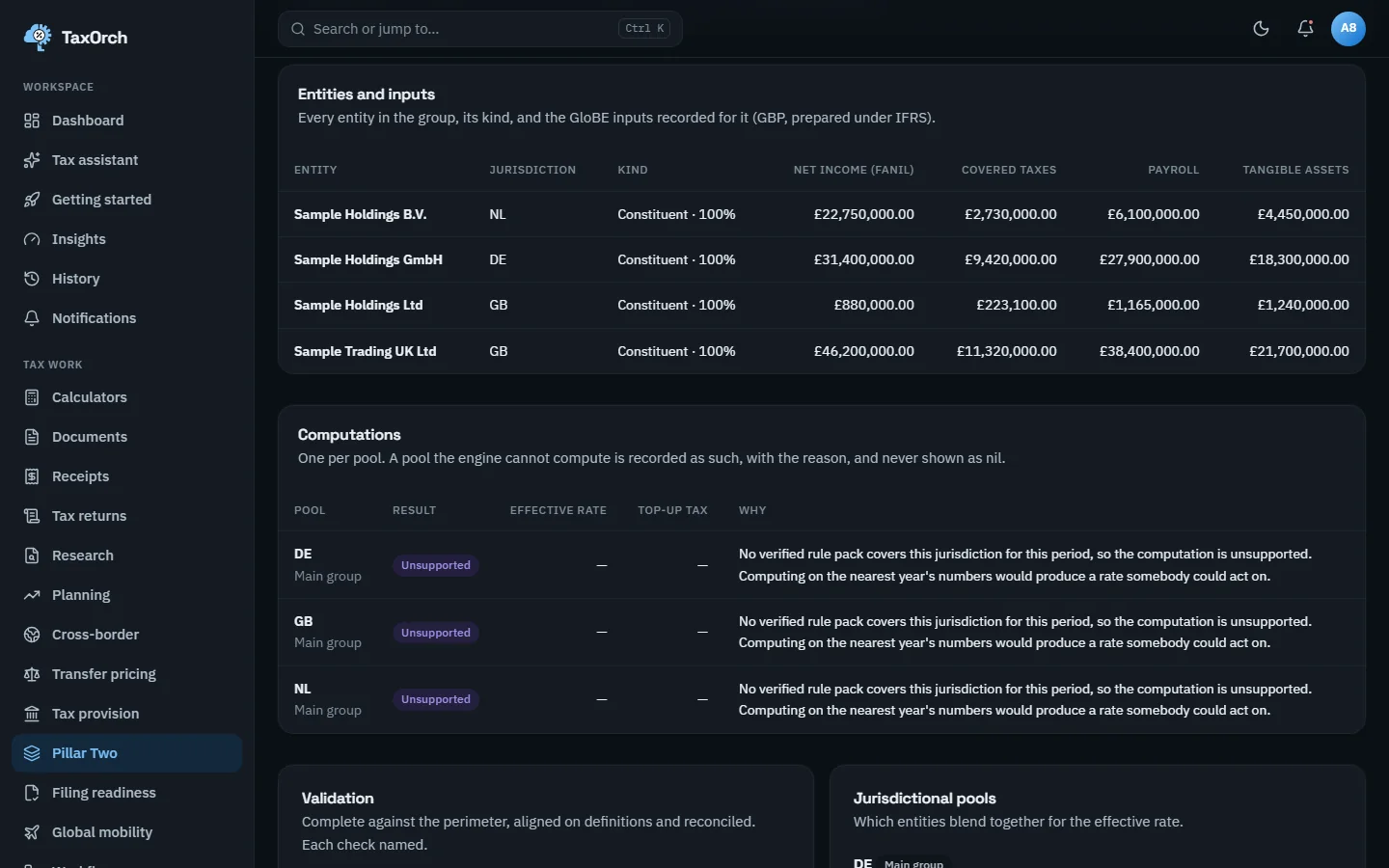
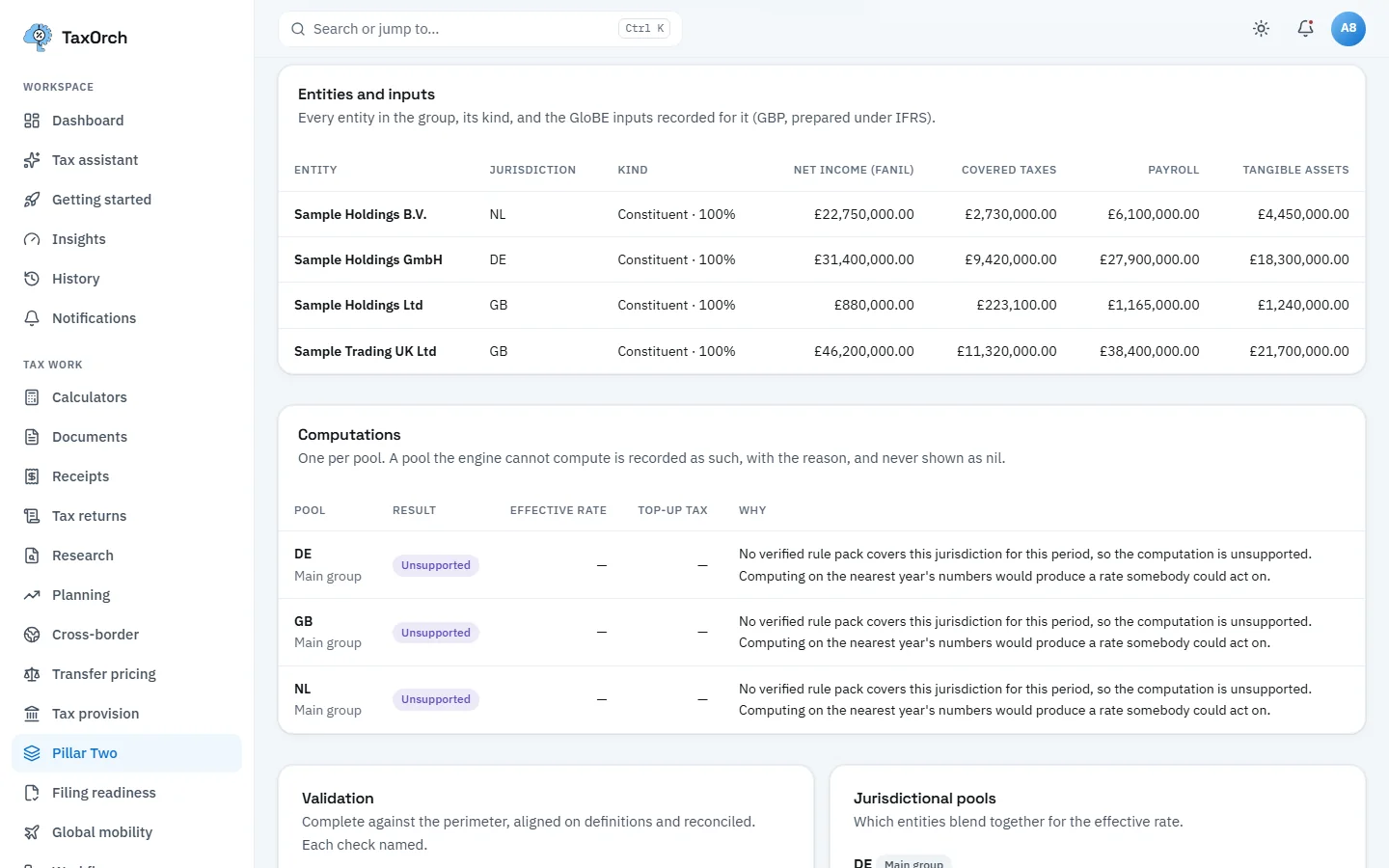
Pillar Two entities and inputs, and three pools recorded as unsupported with the reason.
Validate the dataset
Validation checks the dataset against the perimeter, aligned on definitions and reconciled, with each check named: every entity placed in a pool, no entity in two pools, every exclusion cites its rule, joint ventures and minority-owned subgroups blend separately, permanent establishments placed where they are, required inputs present and usable, every figure on the group's standard. The sample dataset passes all sixteen. Jurisdictional pools show which entities blend together.
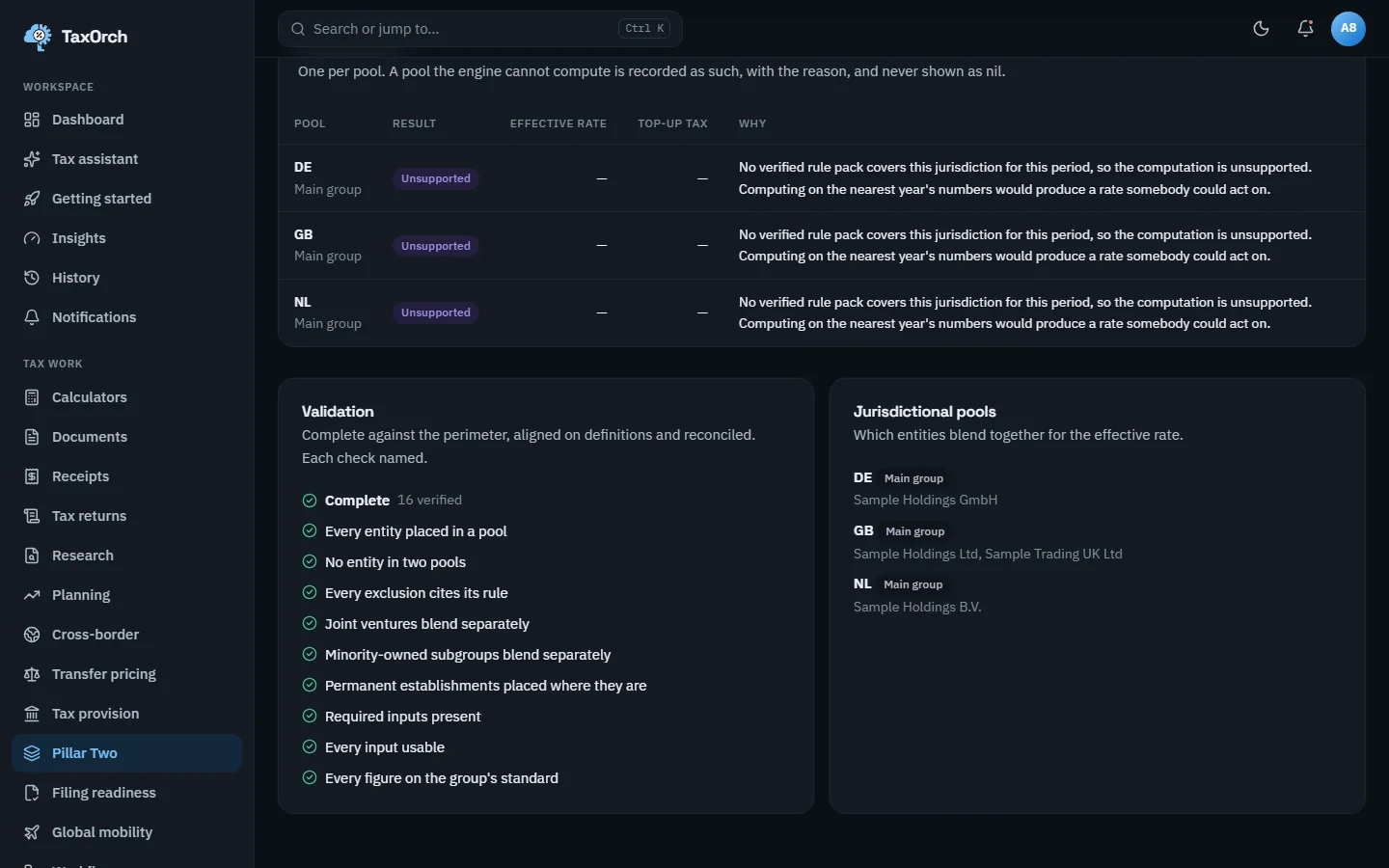
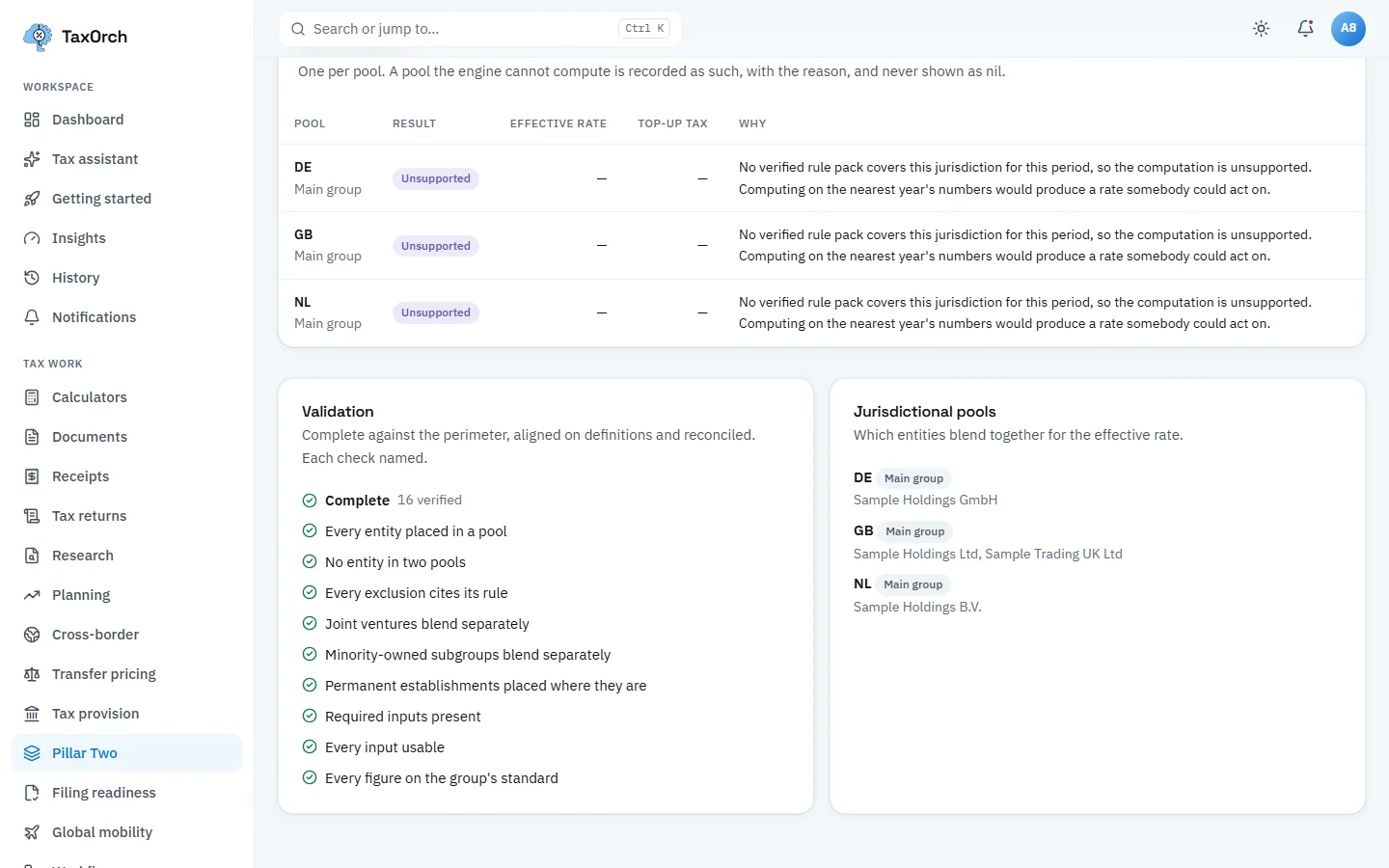
Validation complete: sixteen named checks, and the pools each entity blends into.
Tips
- Have a second person review each schedule; the table shows prepared by and reviewed by side by side.
- Re-check readiness after any trial balance re-import: Sources unchanged will tell you if the bound balances moved.