
Tax figures on these screens are decision support, not tax advice; a professional reviews before anything is filed.
Set up a scenario comparison
Choose Planning, then Scenario comparison. Give it a title, jurisdiction, tax type and year, then a baseline (the facts as they are, one per line) and alternatives that state only what changes. Priya Nair (sample), UK 2025: baseline sole trader with self-employment income 68,000 and turnover 82,000; alternative 1 a limited company with salary 12,570 and dividends 40,000; alternative 2 the sole trader VAT registered.
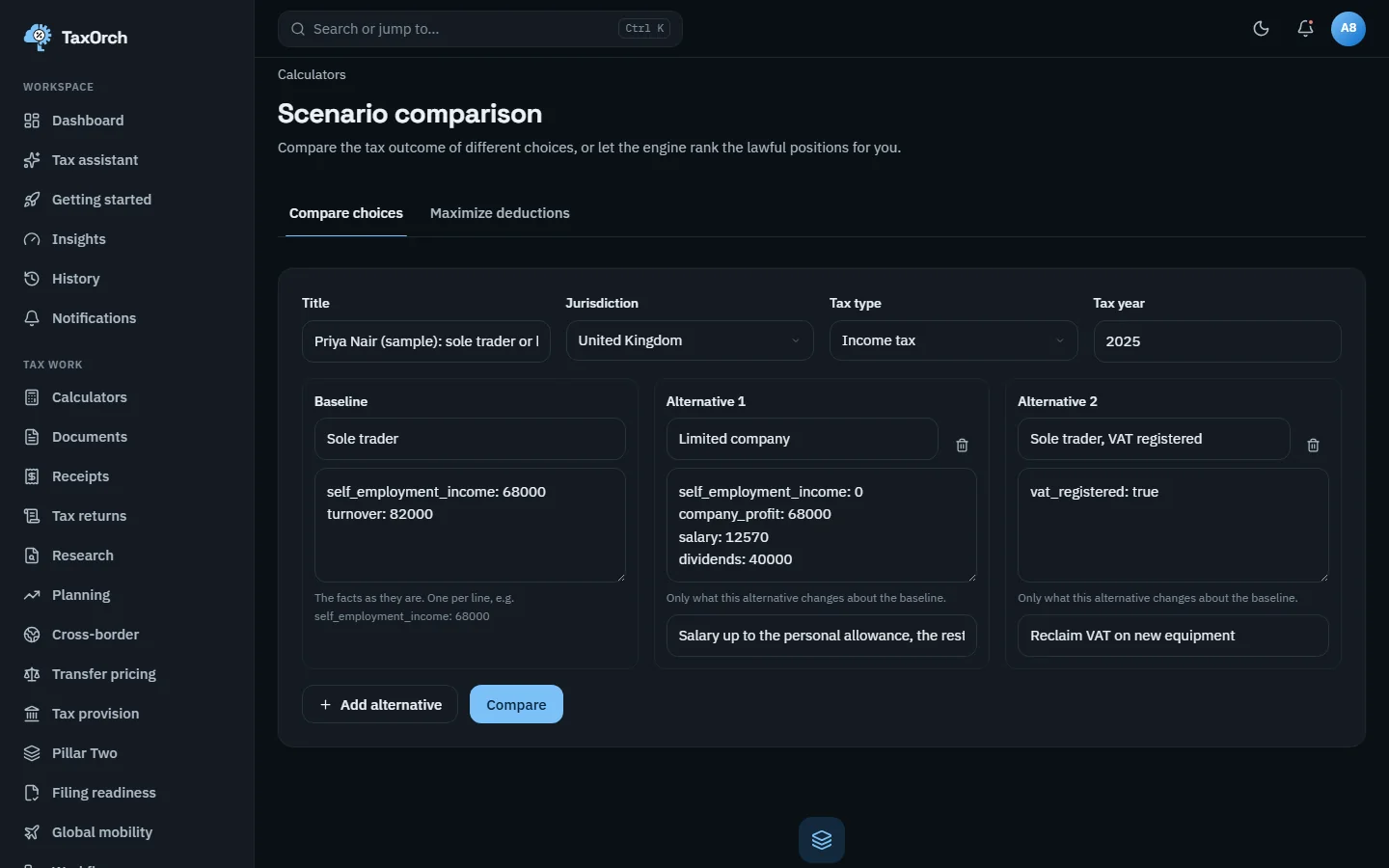
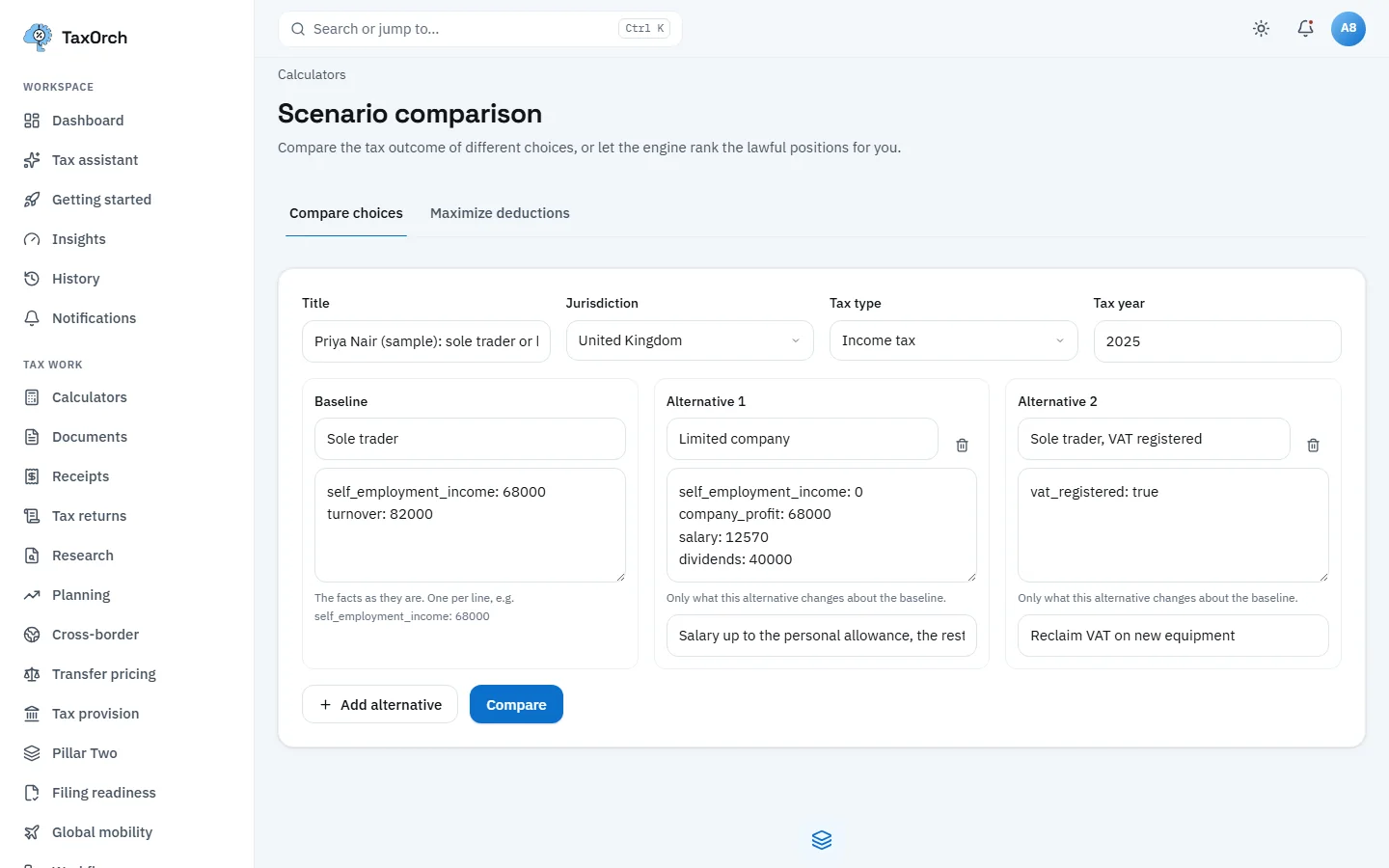
Scenario inputs: a baseline and two alternatives, each stating only what it changes.
Read the comparison, including what is not computed
The result compares facts, new obligations, when tax is paid and why each option was considered. Because the GB 2025 figures have not yet been verified for calculation, the card reads No tax figure and no recommendation yet, the tax liability row says Not computed for every option, and the saving row explains it is shown only when both sides are computed. The footer reminds you that lowest tax is not the same as best.
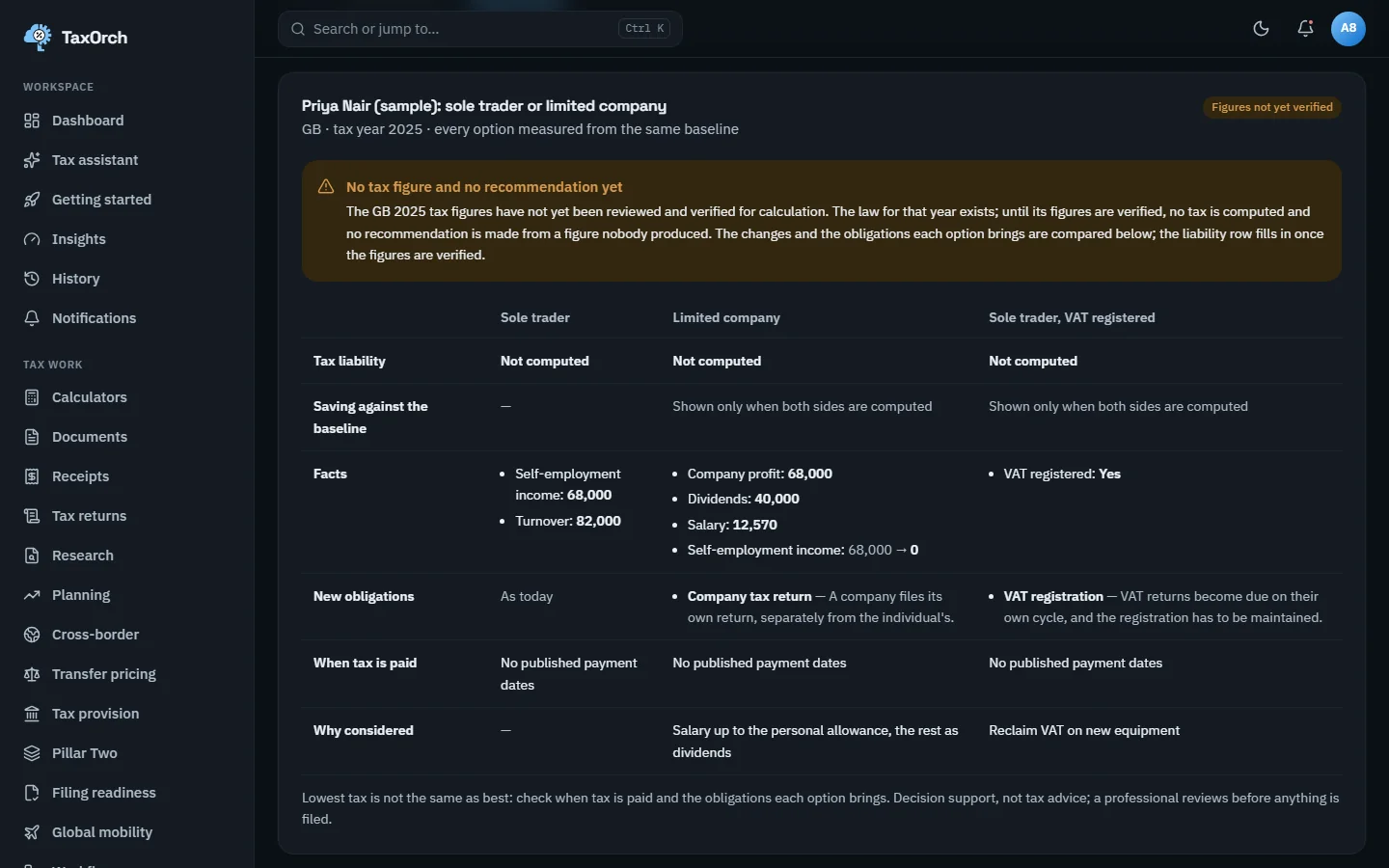
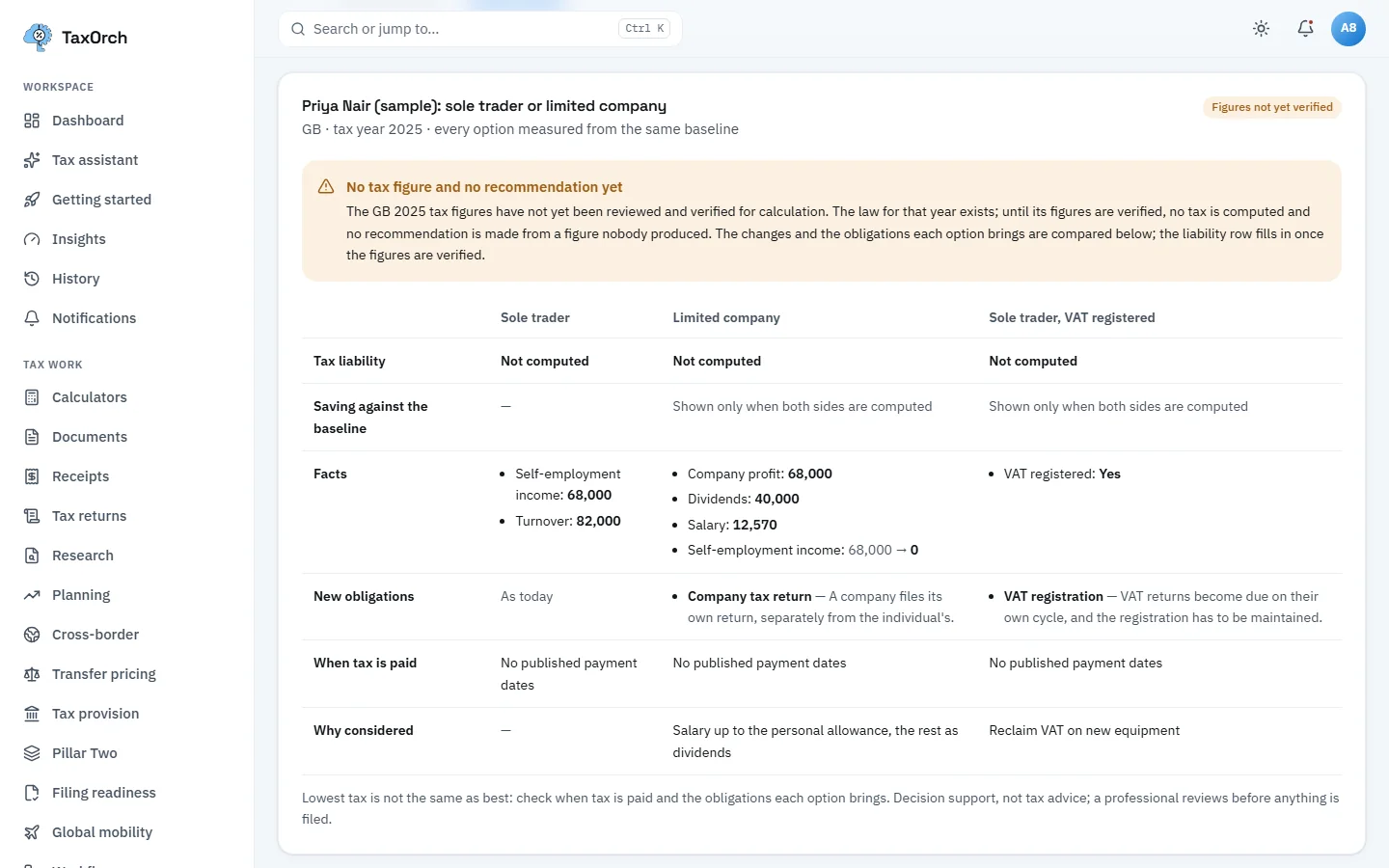
The comparison: obligations and facts per option, and Not computed where the figures are not verified.
Open the deadlines calendar
Choose Deadlines. Four tiles: due in the next 30 days, in the next 90 days, upcoming obligations (28, computed on 30 September 2026) and clients on the calendar (11, across Canada, the United Kingdom, Kenya and the United States). Below, upcoming deadlines soonest first, each naming the rule that produced it and adjusting for weekends: Oliver Grant (sample)'s VAT return is due 6 November 2026 because the 7th is a Saturday, under VAT Regulations 1995 reg. 25(1).
The badge under the title reads Decision support, confirm before relying on a date.
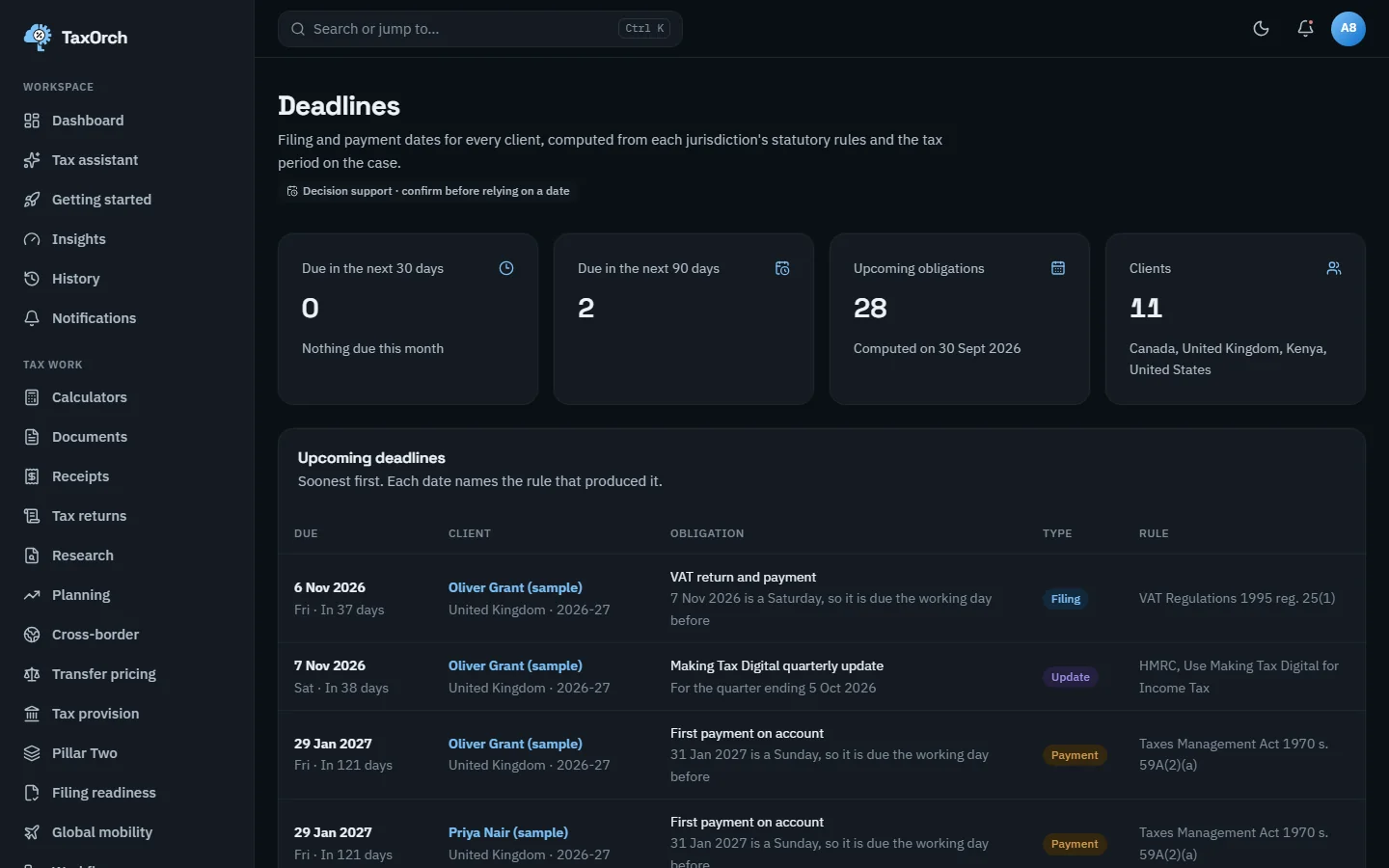
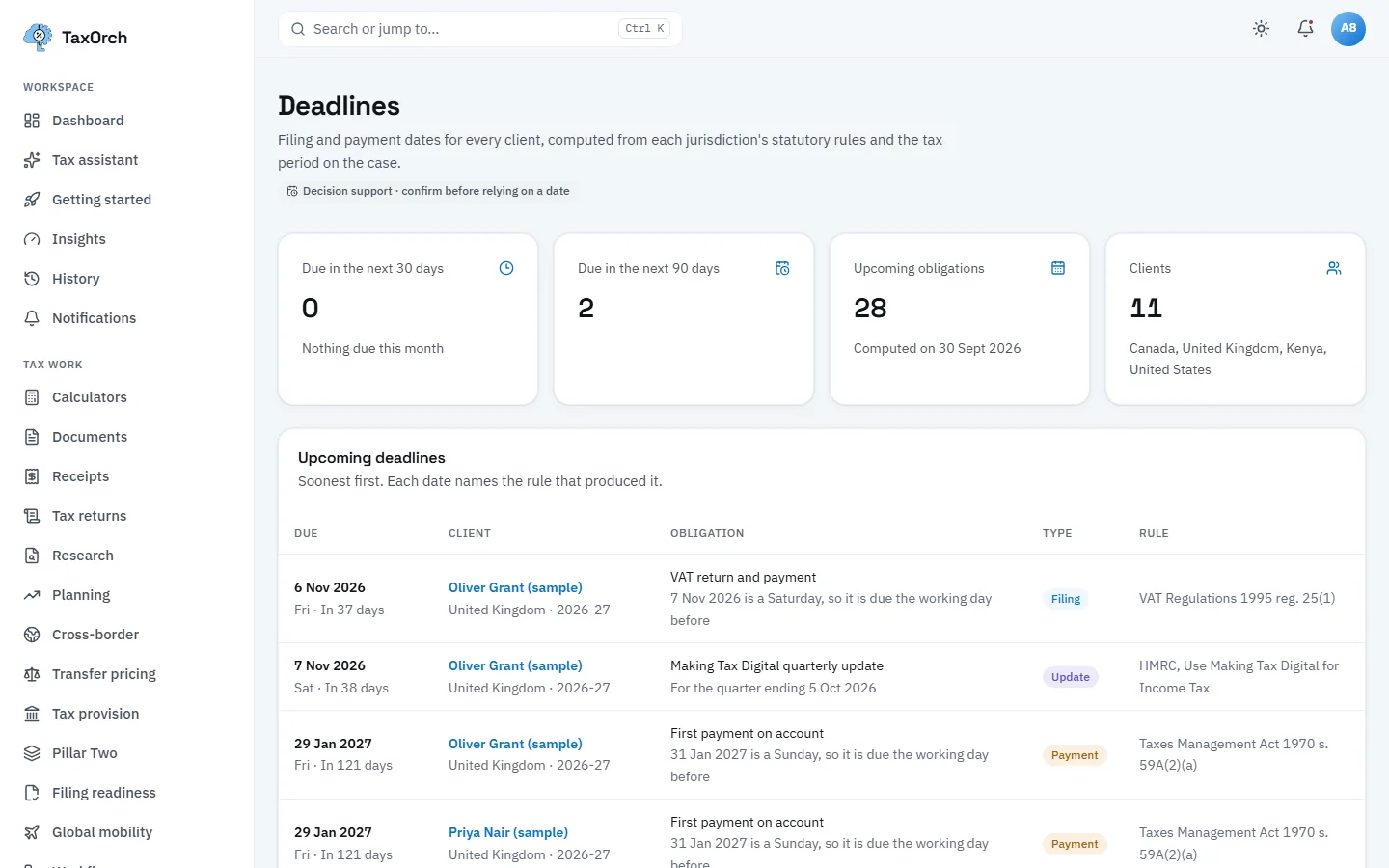
Deadlines: each date computed from the statutory rule, named in the last column.
Read the list by date and by client
The by-date list continues through first payments on account (29 January 2027, Taxes Management Act 1970 s. 59A(2)(a)), a Self Assessment balancing payment (s. 59B(4)) and US Form 1040 filings and payments on 15 April 2027 (IRC sec. 6072(a) and 6151(a)). The Clients view shows each client's period and next obligation, and says when TaxOrch does not hold deadline rules for a country: for Lena Hoffmann (sample) in Germany no dates are shown rather than dates from another country.
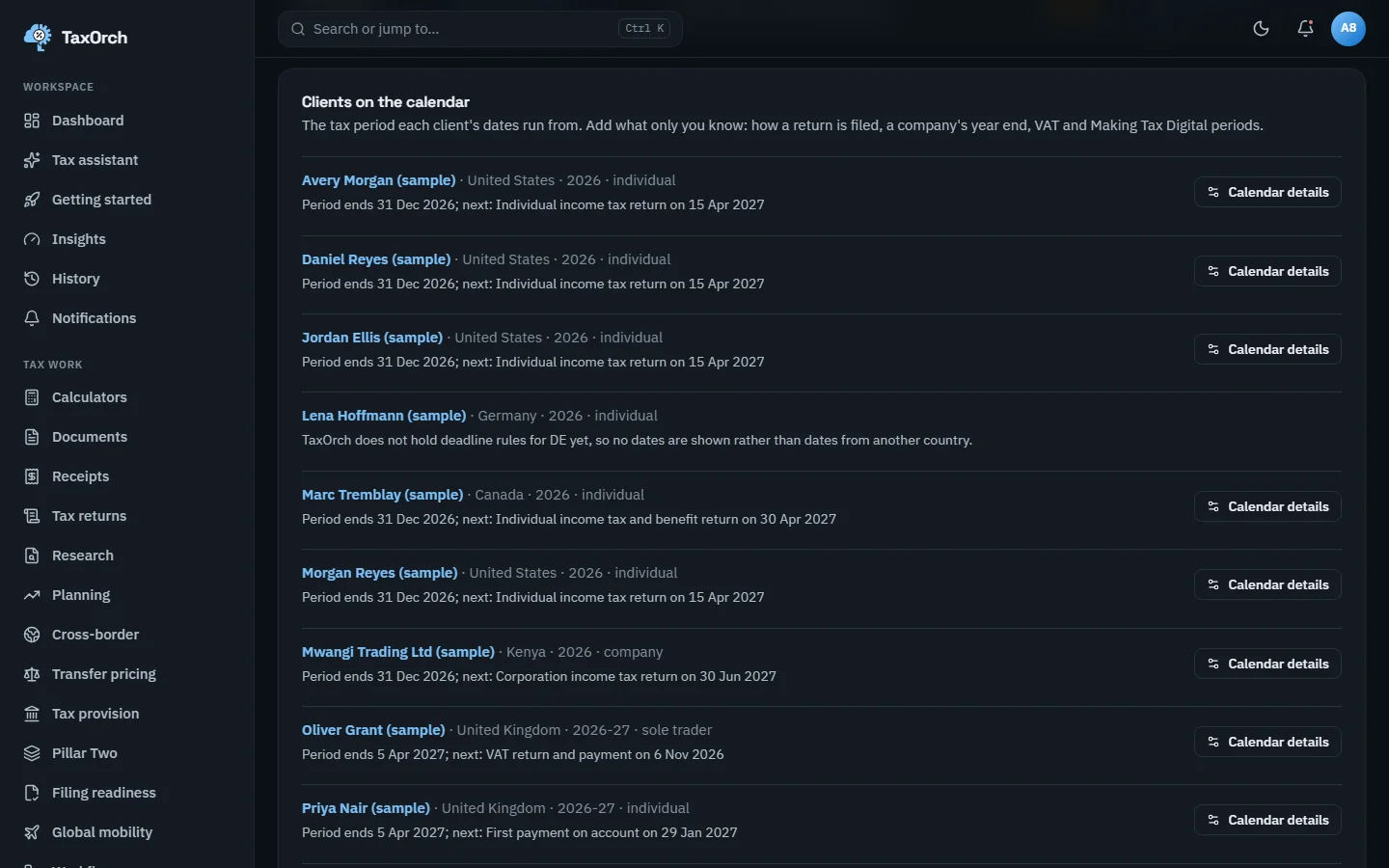

Clients on the calendar: period end and next obligation, and an honest gap for Germany.
IRS filing readiness (Preview, In development)
Choose Filing readiness and a case. For Daniel Reyes (sample), IRS Modernized e-File, the checklist shows 7 of 10 ready: taxpayer identification number, 7216 consent, engagement scope, filing status, maker-checker review, separate-reviewer sign-off and no open issues are Ready; documents and the fact file are Partly ready; calculated figures are Missing because the rules engine declined. The panel Electronic filing reads Not available yet and lists the four authority steps not yet done.
The note at the bottom is the rule: prepare, review, then file yourself through the authority's own service or your filing software. TaxOrch does not transmit returns.
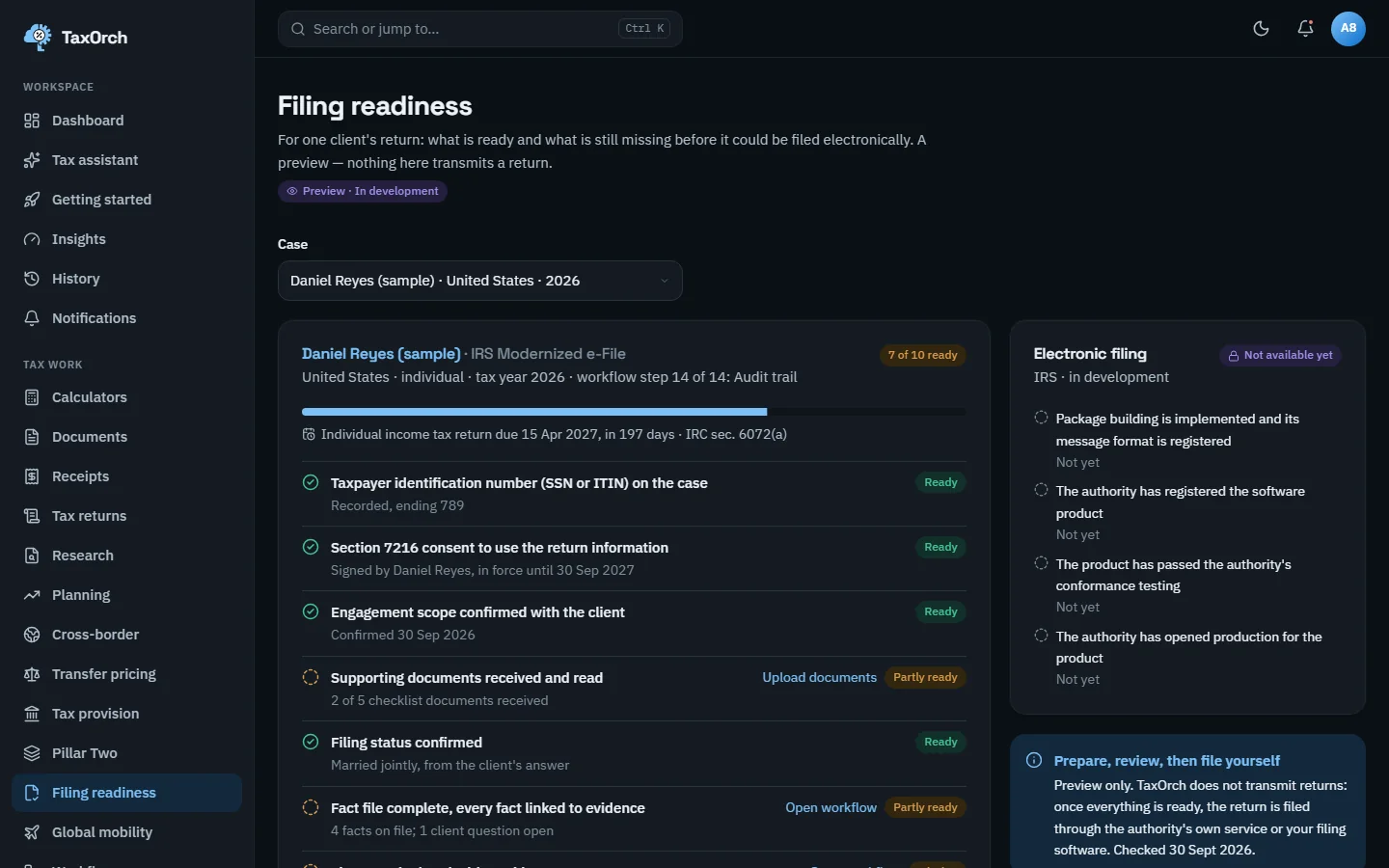
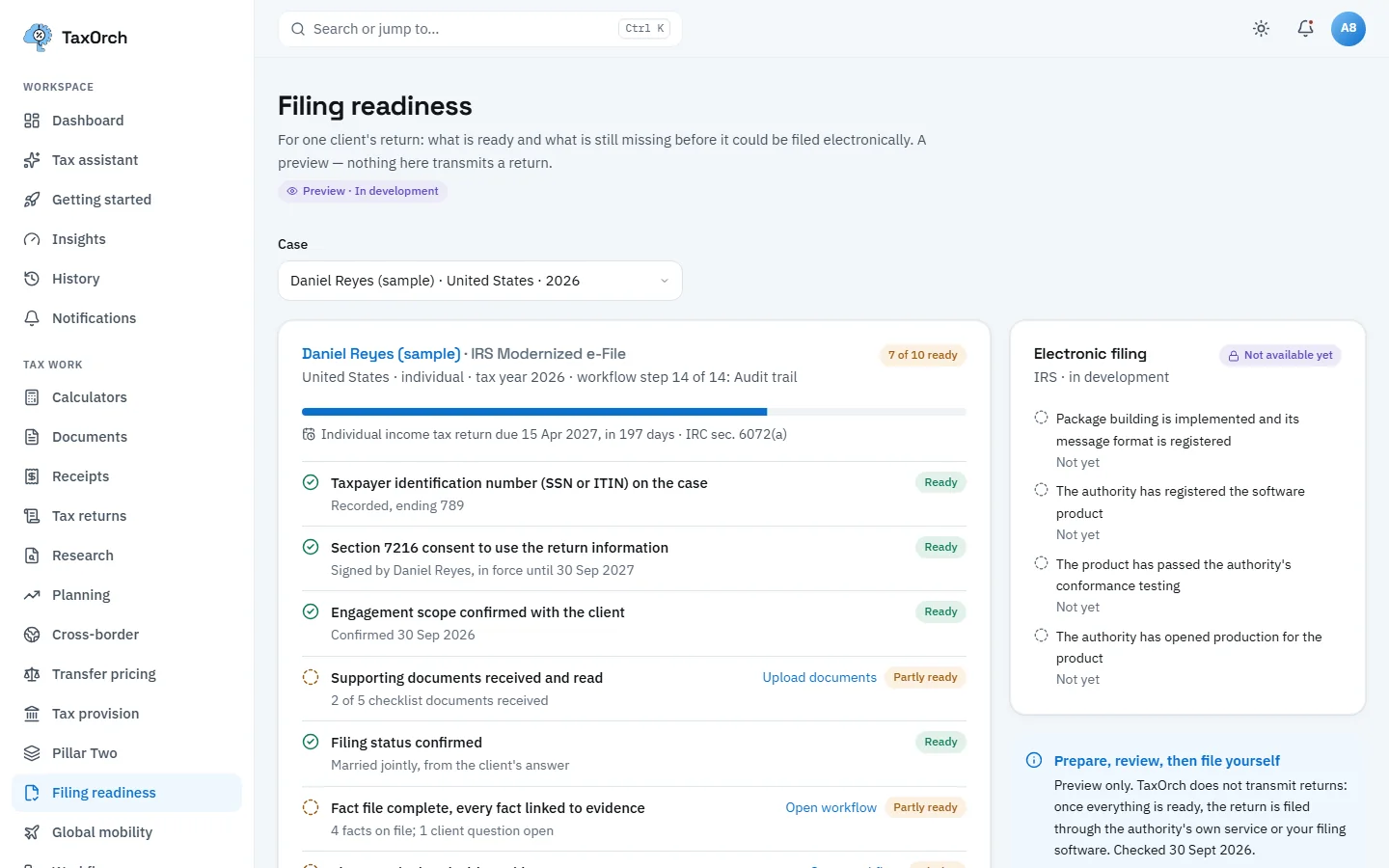
IRS readiness preview: what is ready and what is missing, and electronic filing marked Not available yet.
HMRC Making Tax Digital readiness (Preview, In development)
For Oliver Grant (sample), a UK sole trader for 2026-27, the checklist can be viewed for MTD for Income Tax or MTD for VAT. It shows 5 of 10 ready, the quarterly update due 7 November 2026, and a Missing unique taxpayer reference with an Add reference button. Electronic filing is again Not available yet.
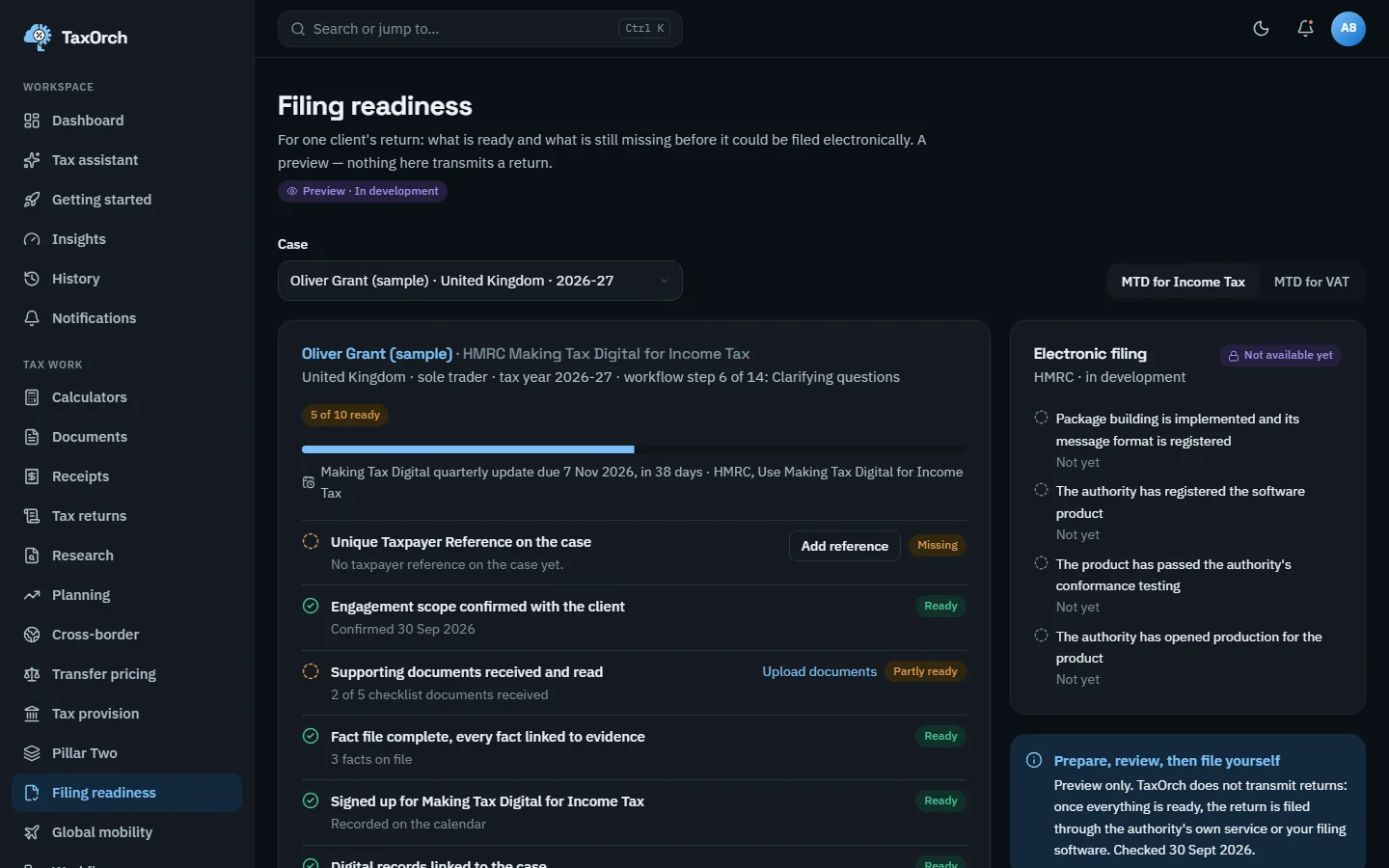
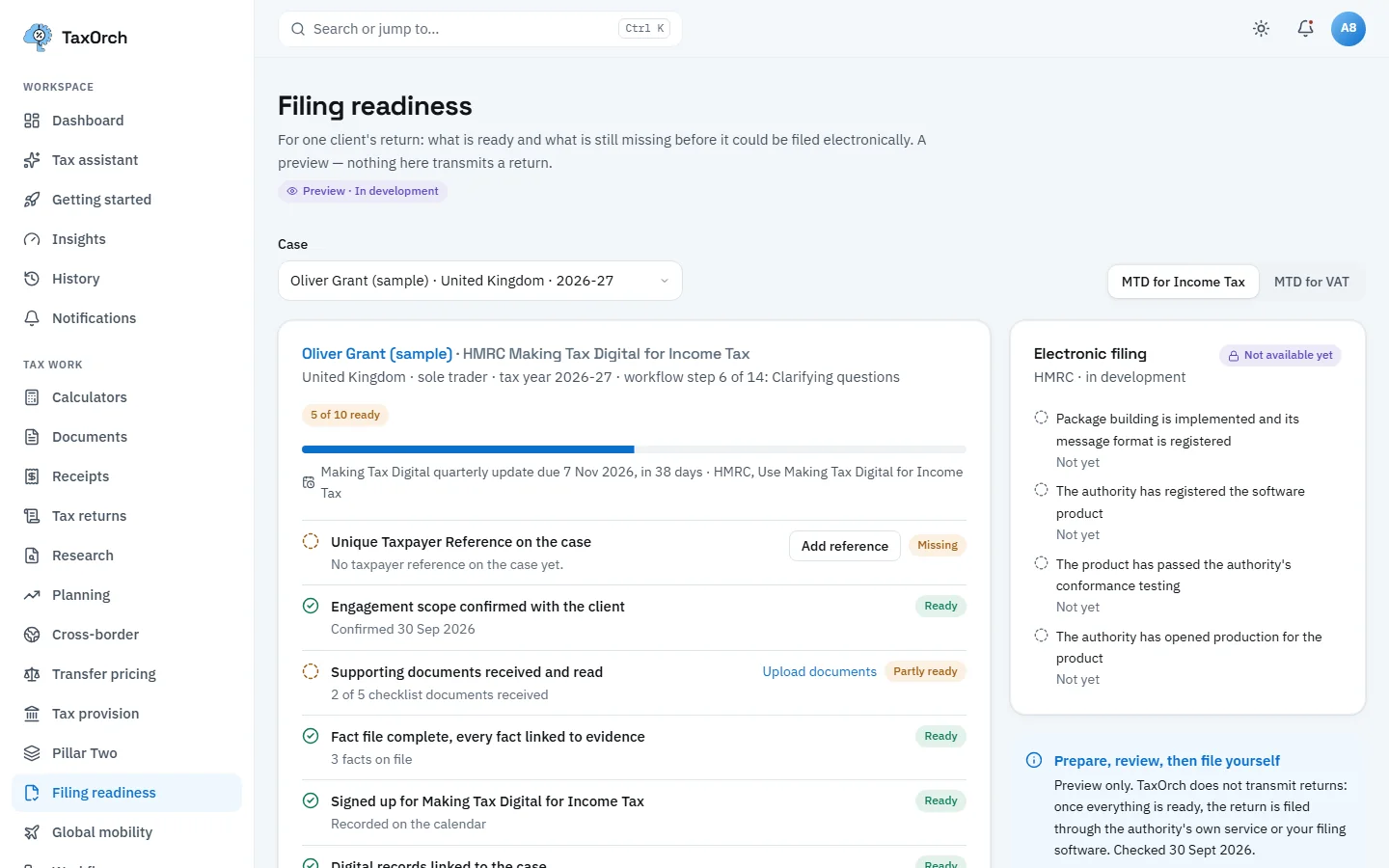
HMRC MTD readiness preview: the quarterly update date, and the taxpayer reference still to add.
CRA readiness (Preview, In development)
For Marc Tremblay (sample), Canada 2026, CRA EFILE readiness shows 4 of 8 ready: the Social Insurance Number and engagement scope recorded, documents Missing (0 of 5 received), the fact file Partly ready, calculated figures Missing because the rules engine declined, the return due 30 April 2027 under the Income Tax Act s. 150(1)(d)(i).
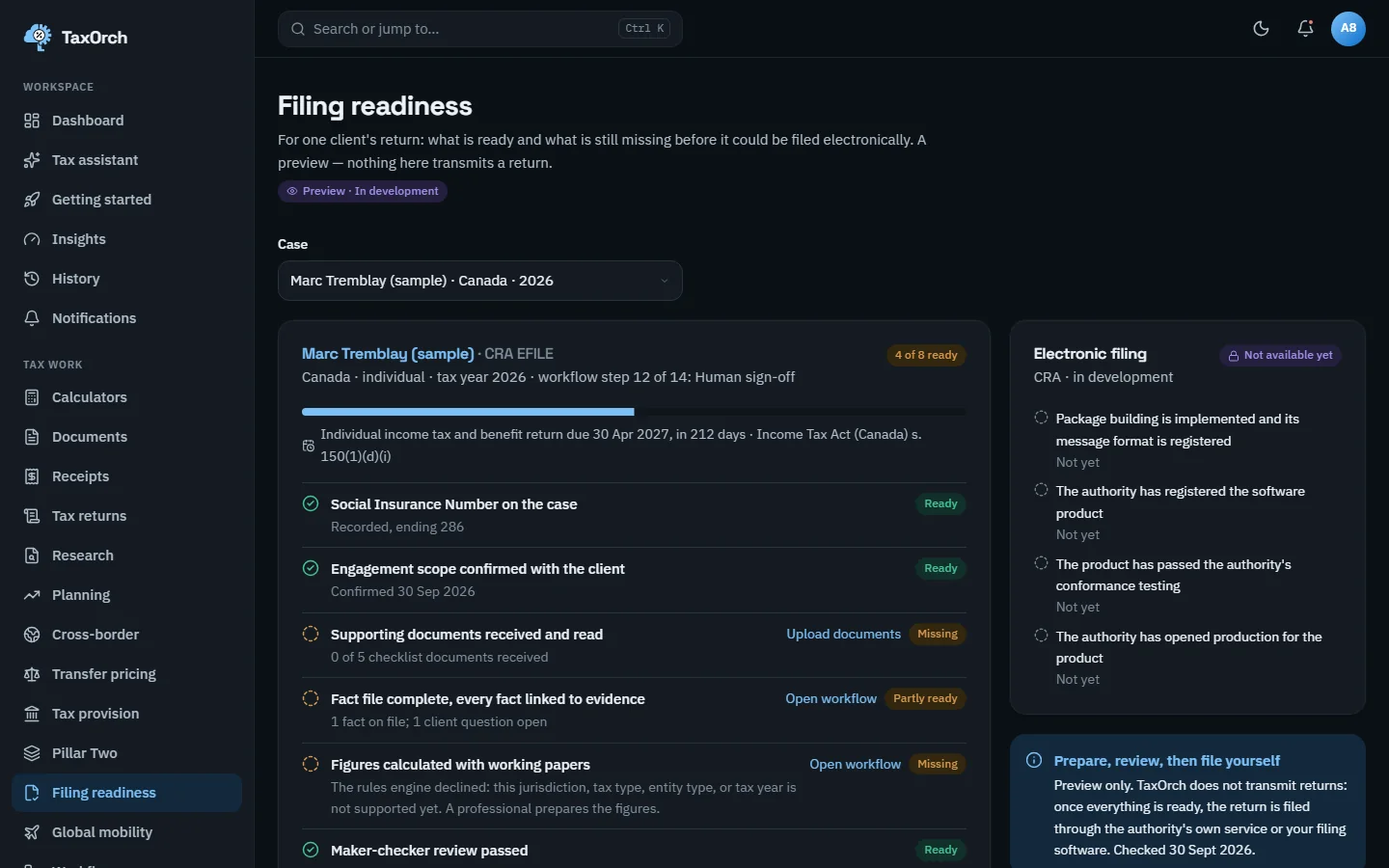
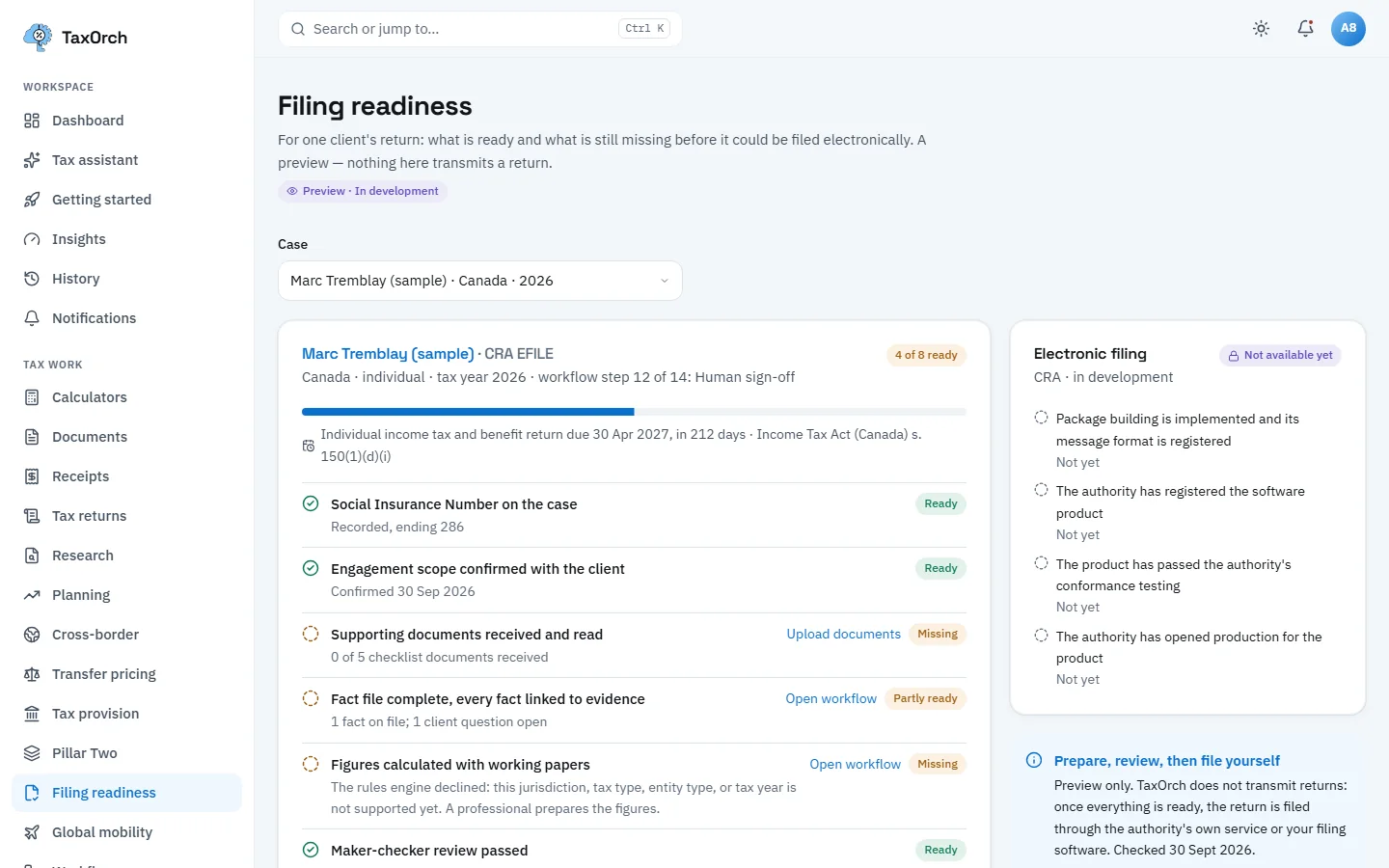
CRA readiness preview: four of eight ready, with the statutory due date named.
Tips
- Enter alternatives as differences from the baseline, not full fact sets; it keeps the comparison readable.
- Add a client's filing method and year end in Calendar details; the calendar only computes what it has been told.
- Use readiness as a checklist for the file, not as a filing step: the filing happens in the authority's service.