
Pillar Two software for the GloBE minimum tax
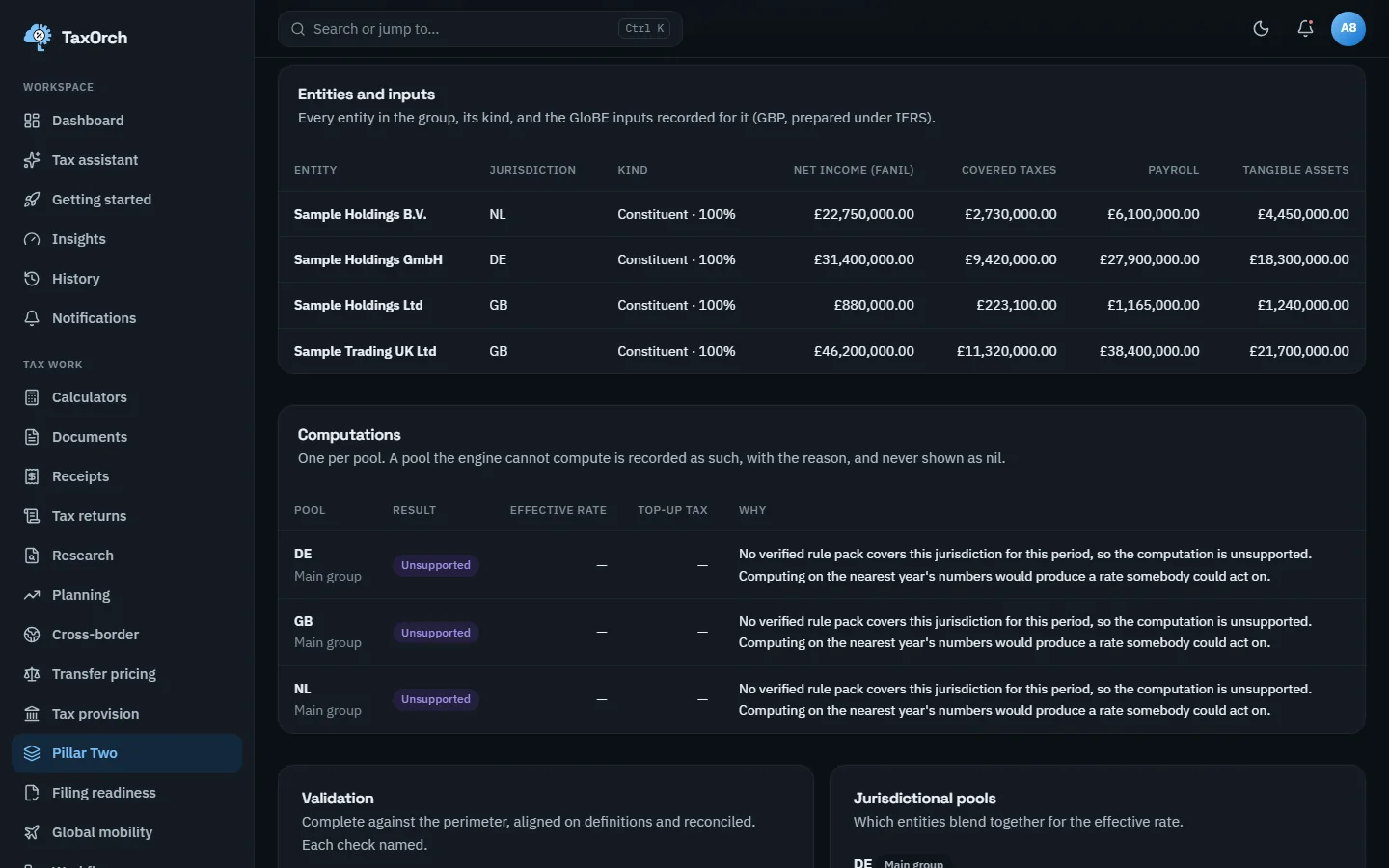
Pillar Two software has to show how the group's data supports a top-up tax figure, input by input. TaxOrch tags every input with its accounting standard and quality, keeps each dataset as an approved version and pools entities by jurisdiction. It computes only for jurisdictions and periods with verified rules, and marks the rest as unsupported rather than nil.
How TaxOrch does it
Inputs with their basis
Each figure carries the accounting standard it was prepared under and a quality flag.
Approved versions
A dataset is approved as a version, so later changes never rewrite what was reviewed.
Pooled by jurisdiction
Entities are grouped by jurisdiction, as the GloBE rules require.
Computed where rules are verified
Where verified rules cover the jurisdiction and period, the computation can be rerun from its inputs; elsewhere it is marked unsupported.
What it does not do
- Pillar Two computations run only for jurisdictions and periods with verified rules; others are shown as unsupported, never as nil.
- It does not file GloBE information returns.
- Use it to prepare and validate group data before computation.
Checklists and guides
Questions buyers ask
Does TaxOrch file the GloBE information return?
No. TaxOrch prepares and evidences the figures; filing stays with the group and its advisers after professional review.
Can a past computation be reproduced?
Yes, for jurisdictions and periods with verified rules: each computation rests on an approved version of its inputs. Where rules are not yet verified, the pool is shown as unsupported.
Bring one engagement and check the file.
Not a demo of a happy path — a real matter, worked through to a pack, so you can look at what a reviewer would actually see and decide whether it holds.
Decision support, not tax advice. A professional reviews before anything is filed.